
Deliver Us: God Hears Our Cry
 Pastor Jason
 Under Pharaoh’s heavy hand (Exodus 1-2), God’s people are worn down in body, heart, and spirit. Their suffering gives voice to one of the oldest prayers of faith: How long, O Lord? It is the cry of people who cannot yet see a way forward but still dare to hope that God hears.
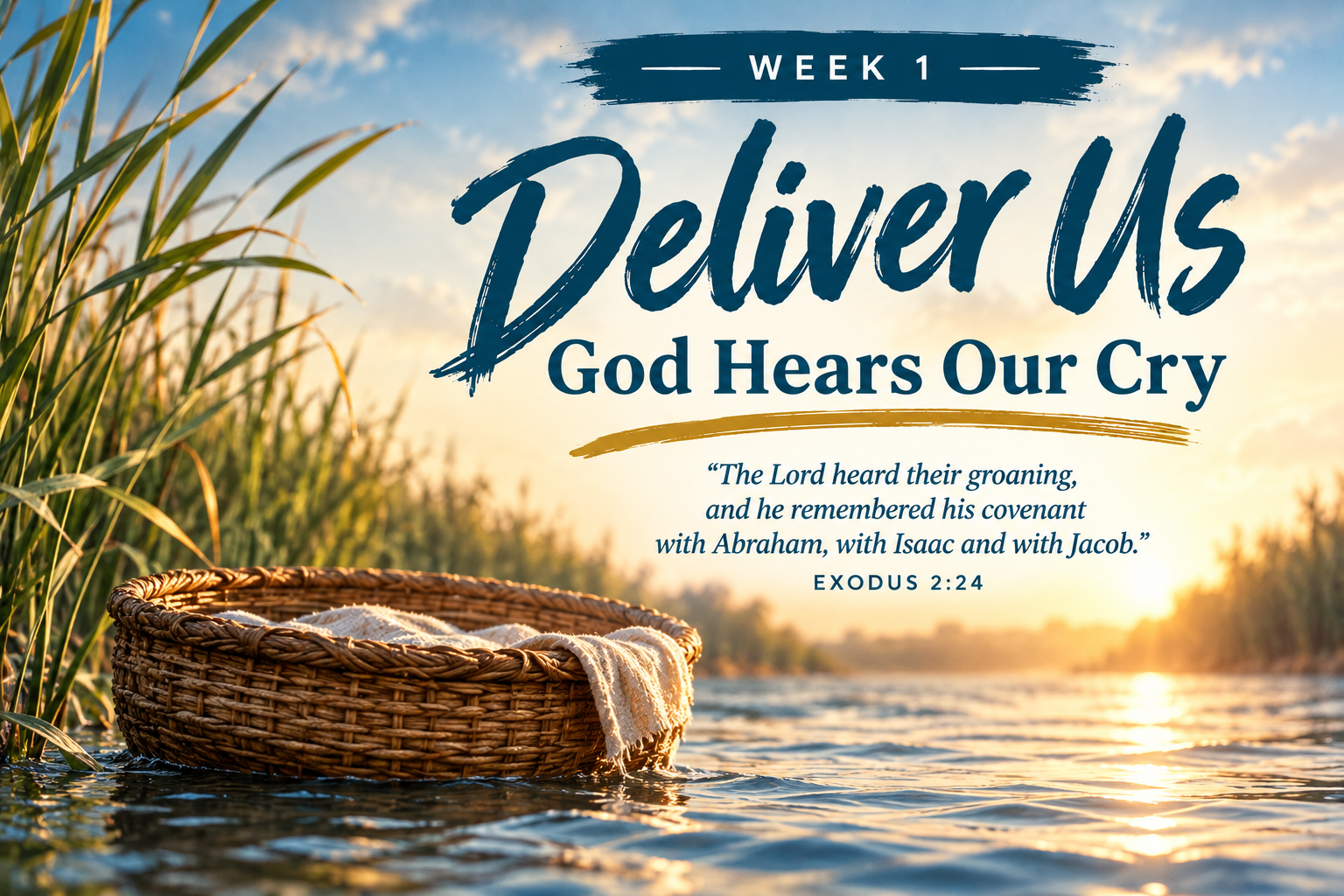
For Yocheved, that suffering becomes painfully personal when Pharaoh orders the death of every Hebrew boy. Her newborn son represents everything Pharaoh is trying to destroy—not only a child, but a future, a hope, a life still waiting to unfold. Faced with circumstances she cannot control, Yocheved does what she can. She hides her son, prepares a basket, places him in the river, and entrusts what she loves most to a future she cannot see.
Her prayer is, in its simplest form, the prayer so many of us know: God, help.
And remarkably, this is where deliverance begins.
Not yet with plagues or parted waters. Not with Moses standing before Pharaoh. It begins quietly—with a grieving mother, a fragile basket, a child on the Nile, and one small act of courageous hope.
Yocheved cannot know what will happen when she releases that basket into the water. She cannot see the story that will unfold from this moment. She simply takes the faithful step that is hers to take and entrusts the rest to God.
What appears to be one desperate attempt to save one child becomes part of God’s deliverance of an entire people.
That is often the shape of hope. We may not be able to change everything before us. We may not know how God will answer our prayers or how the story will unfold. But we can take the next faithful step. We can offer the honest prayer, extend the grace, have the conversation, choose courage, or place into God’s hands what we can no longer carry alone.
The story of Exodus begins with people crying, “Deliver us.” And before they can see any evidence that their circumstances are changing, Scripture tells us that God hears, God sees, and God knows.
So when we find ourselves asking, “How long?” we do so with hope: suffering will not have the final word. God is already at work, sometimes in ways as small and hidden as a basket floating down a river.
Our invitation is to watch for those small beginnings—to recognize the ordinary places where a faithful step might become part of something larger than we can yet see—and to trust that God’s deliverance often begins long before we recognize where the story is going.
Key Scriptures
Exodus 1:8–2:10
Key Takeaways
A Cry for Help Is a Sign of Hope
A plea to God is more than pain—it is trust that God remains present, able to save, and worthy of our call. The question “How long?” carries the hidden confession that suffering does not have the final word.
Small Steps of Faith Matter
Yocheved cannot see how God will save a nation, but she can take one small step for her child. Faith does not require seeing the whole road before moving forward; God can take a basket in a river and turn it into part of a much bigger deliverance.
Deliverance Begins in Hidden Places
God’s saving work does not wait for the dramatic moment when the sea parts. It begins in hidden places, while suffering remains heavy and the path ahead seems impossible. The baby in the river shows that God can be at work before anyone recognizes the rescue.
God Turns the River into Life
Pharaoh aims the Nile at death, but God uses the river to preserve life. Evil cannot determine the final meaning of its own actions; God can work in the very place that seems most dangerous and hopeless.
Questions for Reflection
Why might Yocheved’s decision to place Moses in a carefully prepared basket be understood as an act of faith rather than an act of giving up?
Pharaoh intended to use the Nile as a place of death, yet God used it as part of Moses’ rescue. What does this reveal about God’s power in circumstances that appear threatening or hopeless?
Yocheved could not see how God would rescue all of Israel, but she could take one step to protect her child. How does this help a person understand faithful action when the whole path forward is unclear?
Moses’ rescue began quietly through a mother, a sister, a basket, and Pharaoh’s own daughter. Why might God’s deliverance often be difficult to recognize in its early stages?
What burden, bondage, grief, fear, or situation currently makes it hard to see even the next step? What would it look like to bring that honestly before God with the prayer, “How long, O Lord?”
Recommended Posts

Deliver Us: Never in a Million Years
September 28, 2026
Deliver Us: All I Ever Wanted
September 22, 2026

A Glad And Generous Table
September 8, 2026