
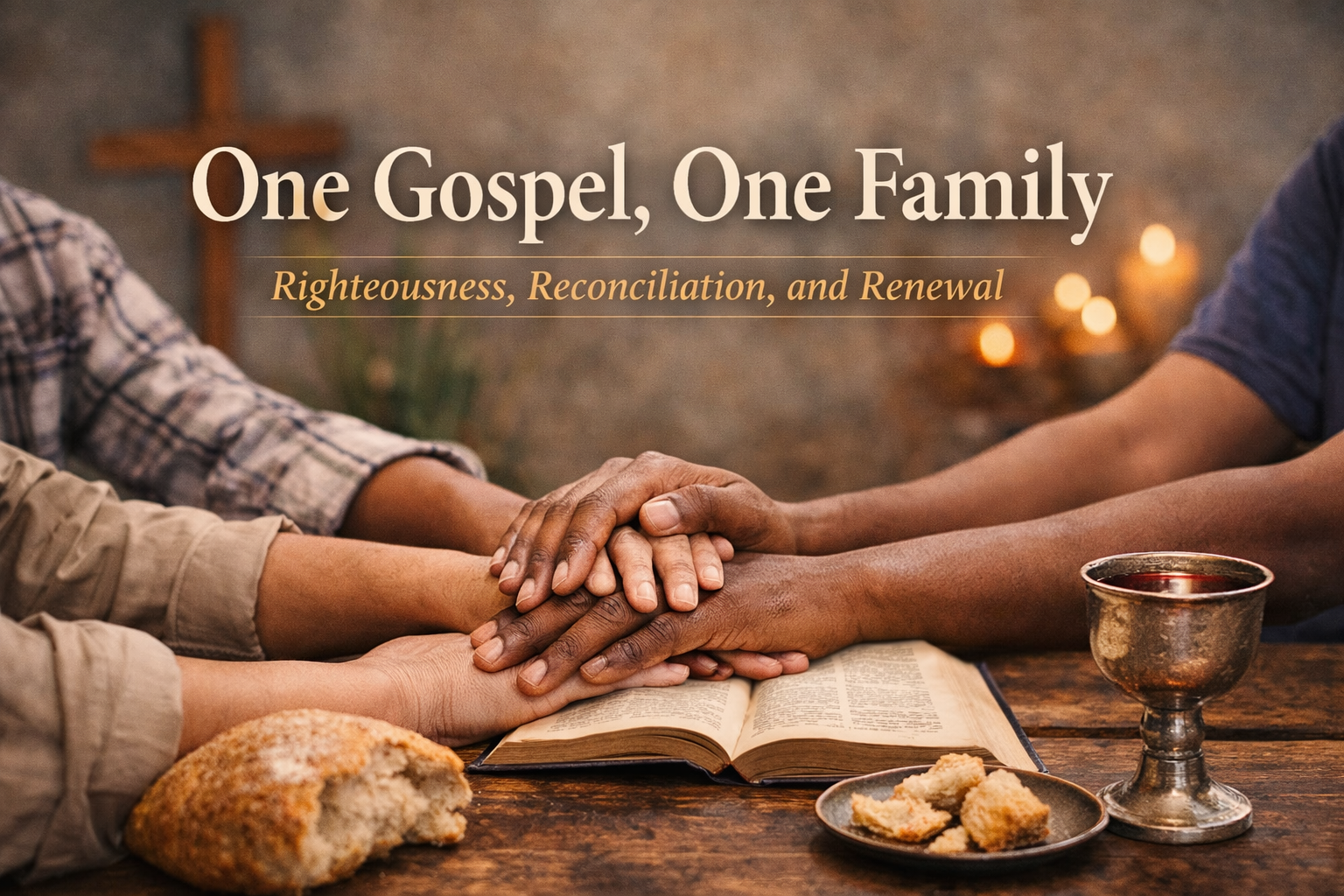
One Gospel, One Family
 Pastor Jason
 Two Sundays ago (yes I am a week late with this blog!), we spent time rethinking what it really means to be “right” before God. Many of us have been taught—explicitly or implicitly—that righteousness has something to do with winning theological debates, having the correct beliefs, or getting religious doctrine just right. But when we listen carefully to Paul’s letter to the Romans, a different picture begins to emerge.
Romans was not written as a systematic theology textbook. It was written to a divided church. Jewish and Gentile believers in Rome were struggling to live together as one community, and both groups believed their own story proved they were especially right with God. Paul steps into that tension and insists that the gospel is not meant to sort insiders from outsiders. Instead, the gospel is the announcement that God is at work restoring relationships and forming one family out of many differences.
We talked about how Paul uses the word righteousness (dikaiosynē) not to describe moral scorekeeping or doctrinal precision, but relational repair. Righteousness is about relationships being made whole—between people and God, and between people and one another. God’s righteousness shows up as faithfulness: God stays, keeps promises, pursues healing, and continues the work of restoration even when people fail. We see this embodied in Jesus, who doesn’t win arguments so much as eat with outcasts, heal the wounded, and reconcile those pushed to the margins.
That’s why the gospel cannot be reduced to a system we master. Systems always create winners and losers. The gospel, instead, is an announcement we receive. Jesus is Lord. God is faithful. New life is possible. And none of us owns that good news. Faith, then, is not a badge of superiority but a posture of trust—trust that God is still at work, still healing, still gathering us together.
Paul’s claim that “the righteous shall live by faith” becomes an invitation to remain in relationship while God finishes the work of making things right. Jew and Gentile, different worship styles, different political views, different stories—we are all held by the same gospel or it isn’t the gospel at all. Communion is a powerful sign of this truth: we come not because we’ve been proven right, but because we are loved and being formed into one family.
The invitation before us is simple, but not easy: to release our grip on being right, to receive the gospel as a gift, and to let love—not correctness—be what marks our life together.
Key Scriptures
Romans 1:1-7, 16-17
Habakkuk 2:4
Key Takeaways
- Righteousness means right relationship – Righteousness is not defined as moral correctness. It is the restoration of broken bonds. It reframes justice as the work of making persons whole with one another and with God, emphasizing repair, faithfulness, and reconciliation over technical correctness. This shifts spiritual life from self-positioning to participation in God’s healing work among people. [42:47]
- Gospel as announcement, not system – The gospel is presented as news to be received, not a list to be mastered. When the good news is an announcement, it resists being owned, weaponized, or used to rank others; it invites trust and transformation. Receiving the announcement opens the way for communal healing rather than competitive righteousness. [54:49]
- God’s righteousness restores relationships – God’s righteousness describes divine fidelity — staying with, forgiving, and pursuing a wounded people. This action aims at renewal: God’s work is to reconcile, heal, and renew creation and communities rather than to vindicate a particular faction. Observing Jesus shows this restorative pattern: healing, eating with outcasts, and reconciling enemies. [48:44]
- Faith sustains relationship over correctness – Living by faith means remaining in relationship while God completes the work of justice and restoration. Faith is trust that God will finish what God began, so communities practice patience, confession, and mutual repair instead of proving theological supremacy. This posture keeps the body together long enough for grace to transform it. [57:19]
Questions for Reflection
We often find ourselves arguing because we are convinced we are correct, but it is possible to be “right but not righteous.” [46:52] Can you think of a recent situation where you were so focused on being “right” that you actually damaged your relationship with someone else? How could you have prioritized “making things right” instead?
Faith is intended to be a bond that connects us, but we often turn it into a “badge” of superiority. [30:33] In what areas of your spiritual life are you tempted to wear your “correctness” as a badge? How can you shift that posture toward one of humble belonging?
The gospel is an announcement that no one owns—not a specific denomination, political party, or social group. [55:16]How does realizing that you don’t “own” the truth change the way you listen to people who have different worship styles or political views than you do?
We are gathered into God’s family not because we have proven ourselves right, but because we are loved. [01:03:08] How can you better reflect this reality to people who feel like they don’t “fit in” or don’t have all the right theological answers?
Recommended Posts

Not Falling Alone
March 10, 2026
When We Fall
March 3, 2026
Falling Under the Weight of the World
February 24, 2026