
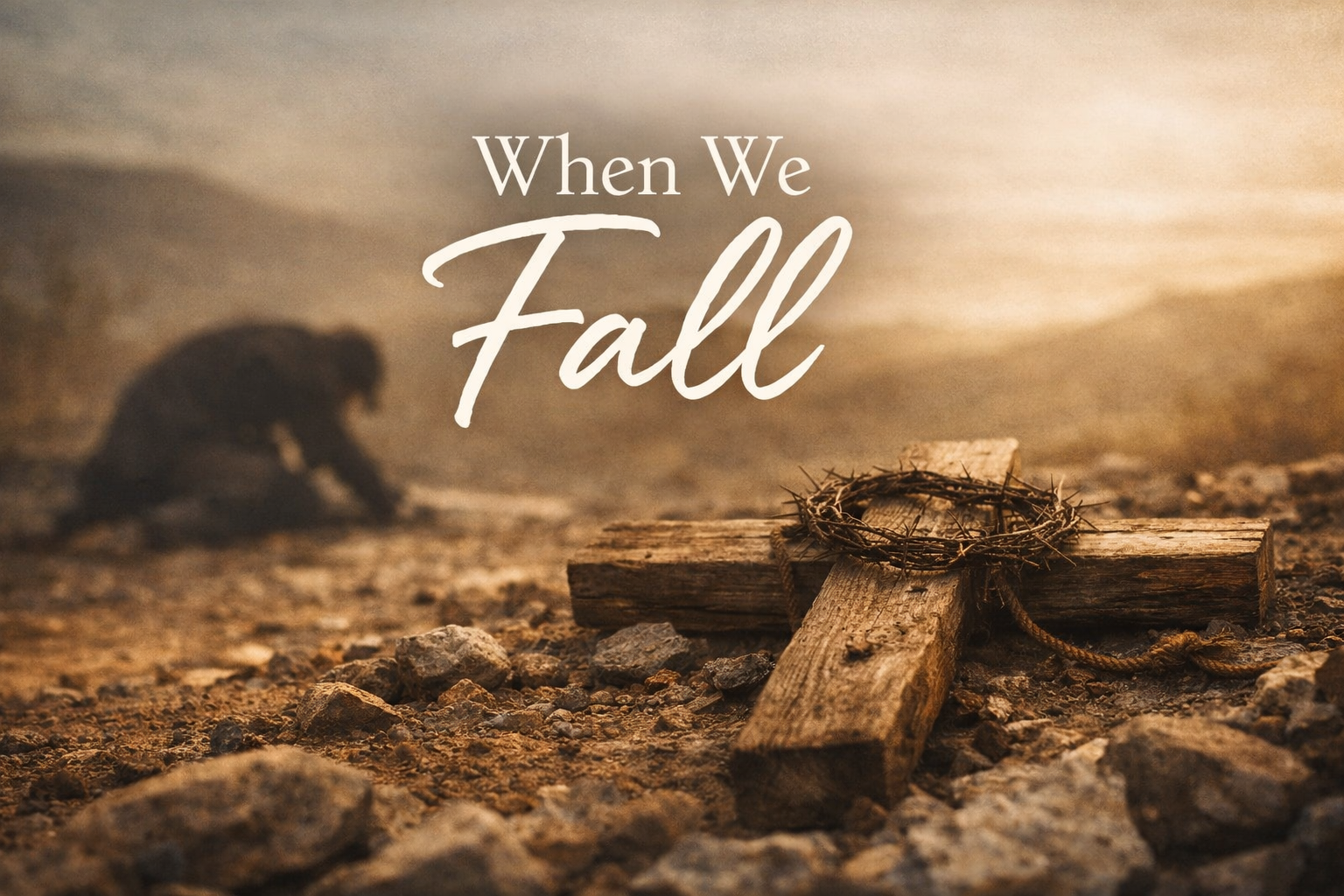
When We Fall
 Pastor Jason
 This week we sat with something most of us would rather avoid: falling.
Falling is something the body remembers — the sudden loss of balance, the scrape of the ground, the ache that lingers afterward. But we don’t just fall physically. We fall when strength gives out. We fall when relationships fracture. We fall when the weight we’ve been carrying finally presses us down. Falling does not prove we are faithless. It proves we are human. Faith does not prevent gravity.
In the Stations of the Cross we’re walking through this Lent, Jesus falls three times under the weight of the cross. The cross is not symbolic or sentimental. It is heavy. Awkward. Physical. His knees buckle. The road is long. And Jesus’ falls are not weakness — they are God choosing to meet us on ground. The Son of God knows what it is to carry more than a body should carry. He knows the dust. He knows the weight.
Scripture gives us a language for this rhythm of falling and rising. In Micah, we often read, “When I fall, I will rise” (Micah 7:8). But the Hebrew is even tighter than that — less a neat if/then formula and more a rhythm: I fall. I rise. Darkness. Light. Falling is assumed, but it’s not the end. God meets us in the fall, holds us in the fall, and calls us to rise, so that what defines faith is not avoiding the ground, but refusing to stay there.
Standing, then, is more than simply getting back on your feet. Standing is what you do when your knees still ache. It is what you do when the road is still long. Standing is not proof that the fall didn’t hurt. Standing is proof that the fall didn’t finish you.
And we do not stand alone. Scripture promises that “the Lord upholds all who are falling.” Not who have fallen — who are falling. God’s work is not preventing every collapse, but meeting us in it and holding us as we rise.
When we fall, we are not abandoned. And in Christ, we rise.
As you move into this week, pay attention to the places where the ground feels unsteady. Notice where you are tempted to stay down — and where you sense even the smallest invitation to stand again. The pattern of falling and rising is not a sign that something has gone wrong. It may be the quiet evidence that God is still at work, steadying your steps.
Key Scriptures
Micah 7:7-9
Lamentations 3:1-3,16-24
Psalm 145:14
Isaiah 46:3-4
Key Takeaways
- Falling is a human rhythm – Falling repeats across embodied life—physical, emotional, moral, and spiritual—and the Bible presents it as expected, not exceptional. Naming falling as part of being human frees us from shame and opens space for disciplined response rather than denial. That rhythm invites us to stop pretending that that we will never collapse and instead to think about how we can prepare to rise when we do fall. [37:59]
- God is present in the fall – God does not wait until the suffering is over to show up. God holds us in the middle of the fall, steadying us even as we lose our footing. When we begin to see that, our trials no longer feel like abandonment. Instead, trials are places where grace quietly meets us and teaches us how to endure. [42:36]
- Christ shares the body’s weight – The crucifixion is physical — knees buckling, gravel in the mouth, a body under weight. In Jesus’ fall, we see that God enters our weakness rather than avoiding it. Christ has carried the burdens we carry, and because he has shared our weight, we do not rise alone. [45:27]
- Rising requires choosing to stand – Standing is an act of defiance against gravity and despair. But new must choose to stand, to defy the fall! Rising does not erase the fall’s reality, but it does reorient the heart to trust and persevere, often with help from others and the Spirit. Refusing to stand is the only true obstacle to the rhythm God intends. [40:23]
Questions for Reflection
“Falling is a human rhythm… not evidence that something has gone wrong with your faith.” [39:50] Why is it so difficult for many people of faith to accept that falling is a normal part of the human experience and not a sign of God’s absence or punishment?
Psalm 145:14 says God upholds those “who are falling” (present tense). What does it mean that God’s support is active in the midst of our collapse, not just waiting for us at the end of it? How does this reshape our experience of trials?
What is one area of your life right now—physical, emotional, relational, or spiritual—where you feel the weight of the world pressing down and the potential for a fall? How can you acknowledge this weight honestly, without shame, as part of the human rhythm?
The pattern is “I fall, I rise.” [37:59] The only thing that breaks this rhythm is refusing to stand by saying “I can’t.” [40:23] Where have you been tempted to say “I can’t” and stay on the ground? What is one small, defiant step you can take to choose to rise, even in dependence on God’s strength and not your own?
Who in your life needs to be reminded that they are not alone in their fall? How can you practically embody God’s upholding presence for them, helping to steady their steps or sit with them in the darkness?
Recommended Posts

Deliver Us: Footprints on the Sand
October 13, 2026
Deliver Us: Simcha Chagiga
October 7, 2026
Deliver Us: Never in a Million Years
September 28, 2026