
Falling Under the Weight of the World
 Pastor Jason
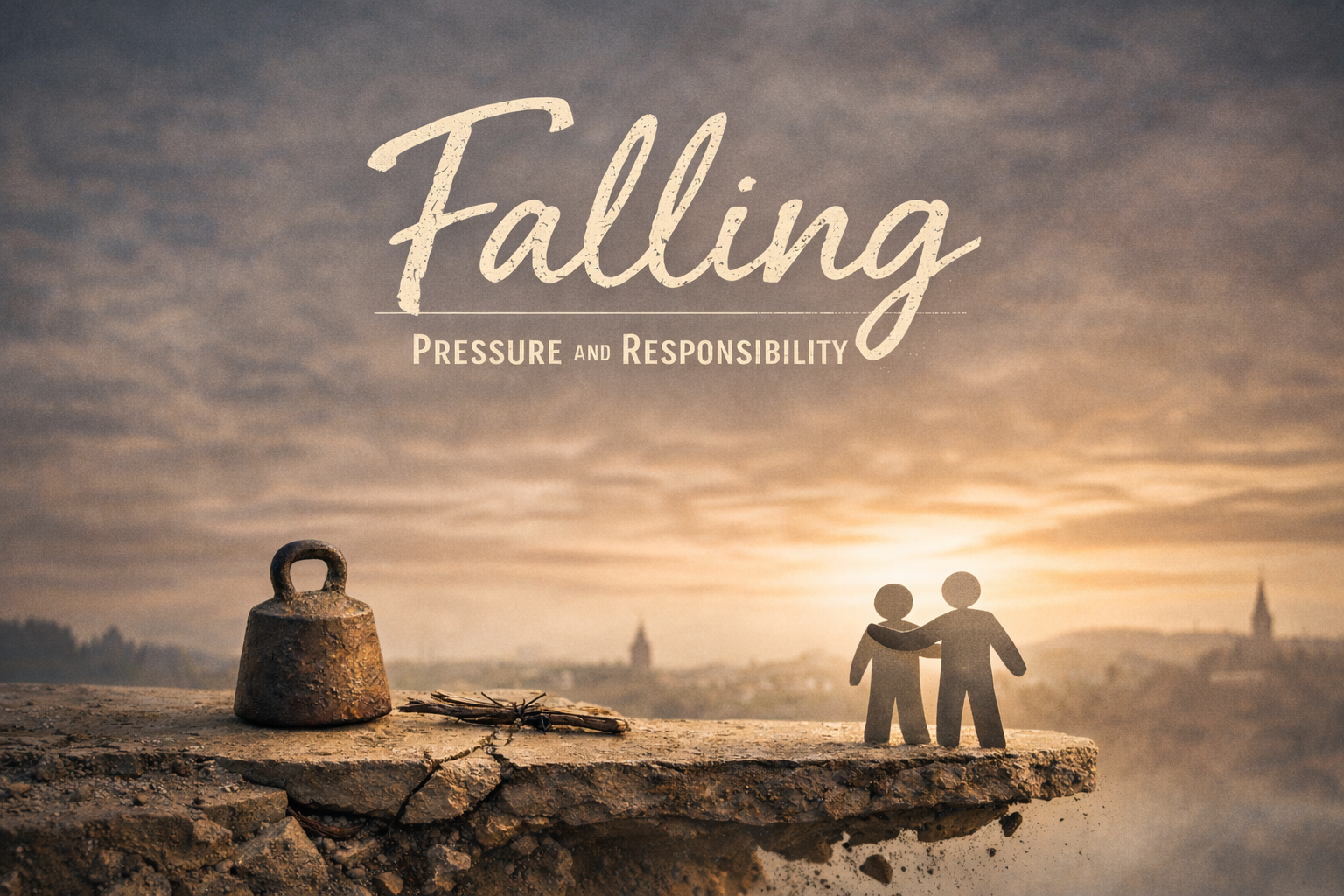
 This Sunday we began our Lenten series, Falling, a journey through the Stations of the Cross that invites us to walk with Jesus into the places where the ground gives way—discovering that Christ meets us in our weakness, our vulnerability, and our waiting, and does not leave us there alone. Throughout this season, we will explore what it means to lose our footing—personally, communally, and spiritually—and to discover that Jesus enters those places with us. Week one begins with Station I (Jesus is Condemned to Death) and Station II (Jesus takes Up His Cross). These stations are not about Jesus physically falling under the cross. They are about something deeper: the fall that happens when pressure builds and the ground gives way.
In Luke 23, we watched the scene of Jesus before Pilate and Herod. Pilate finds no guilt. Herod sends him back. The crowd grows louder. Barabbas is released. And even though no one person fully owns the decision, the machinery keeps moving. Pressure builds until someone must carry the weight—and in this story, it lands on Jesus. Isaiah 53 helps us see what is happening beneath the surface: the suffering servant bears what others cannot or will not face, becoming the place where fear, blame, and tension collect within a community or society.
We reflected on how this dynamic unfolds not only in one courtroom long ago, but in the world as we know it. When tension rises and responsibility is diffused, pressure does not simply disappear—it looks for somewhere to be released. It is like a pressure cooker on a stove: if the pressure is not acknowledged and shared intentionally, it will release itself.
Fear must land somewhere.
Anger must land somewhere.
Uncertainty must land somewhere.
And this pattern repeats itself whenever we refuse to face tension together and share the weight. It is about how the world holds—or fails to hold—its own pressure.
The New Testament often uses the word kosmos for “world,” meaning the ordered arrangement of life—the structures and patterns meant to hold communities together. These arrangements are intended for good; they help life function and organize responsibility. But when we stop tending them—when we fail to interrupt fear, examine tension, and share responsibility—momentum takes over. And momentum always lands somewhere. In Luke’s Gospel, it lands on Jesus.
The cross reveals not only how pressure moves through a world under strain, but where Christ chooses to stand when it does. Before Jesus ever falls under the weight of the cross, he falls under the weight of a world releasing its pressure. And he does not step away. He enters that space willingly, bearing the weight that gathers there.
As we continue through Lent, we will follow him along this road. We will watch him fall. We will ask why he falls. And we will begin to notice where the ground gives way in our own lives and in the lives around us. Above all, we will trust that the one who stepped into the weight of the world walks with us still, leading us toward shared responsibility, deeper compassion, and the hope of resurrection.
Key Scriptures
Luke 23:13-25
Isaiah 53:3-7
Key Takeaways
- Pressure builds—and it looks for somewhere to go – Every community carries tension: fear, stress, frustration, uncertainty. When that pressure isn’t faced and shared honestly, it doesn’t disappear—it looks for somewhere to land. Often it settles on one person (or one group of people). Learning to notice where the weight is falling helps us recognize when harm is bigger than one individual and invites us to share responsibility instead of shifting the burden onto others. [33:28]
- Jesus stands where blame falls – In the Gospel story, Jesus steps into the place where blame and pressure gather. He does not avoid it; he bears it. His response shows us a different way to live—not stepping back when the weight lands on someone, but standing with them in compassion and courage. [40:17]
- Lent invites slow inward work – Lent is a season for honest reflection and spiritual renewal. It invites us to slow down, notice what needs healing in our hearts, and allow God to reshape us. This kind of inward work helps us resist quick fixes and learn healthier ways of sharing burdens, so fear and frustration are not pushed onto others. [11:46]
- Notice where the ground is giving way – This story invites us to pay attention to where pressure is building and where the weight is falling on someone. Following Jesus means stepping in with care and sharing the burden so no one has to carry it alone. Faithful communities learn to notice these moments and hold one another up when the ground begins to give way.
Questions for Reflection
The sermon described a dynamic where “no one takes responsibility, but everyone participates.” Where do you see that happening in your own life or community? When the weight lands on someone (or some group), what might it look like to respond differently? What might it look like to help create a space where the weight can be shared instead of shifted?
Pressure seeks a place to land, often finding the weakest point in a system or community. [33:28] Where have you seen this dynamic play out in your workplace, family, or social circles? What did it feel like to be near that moment – whether the pressure landed on you or on someone else?
Jesus stands where blame falls, choosing to absorb what the world refuses to hold. [40:17] Think of a time when the weight of a situation fell on someone else. Did you step in or step back? What might it look like to respond differently next time?
Lent invites slow inward work and honest reflection. [11:46] What is one area of your inner life—a fear, anger, or uncertainty—that, if left unexamined, might be displaced onto someone else? What would it look like to bring that to God this week and allow it to be held with grace?
Recommended Posts

A Glad And Generous Table
September 8, 2026

When The Storms Come
September 1, 2026
Remember the Water
August 25, 2026