
Learning to Live Together
 Pastor Jason
 This past Sunday we brought our series on Romans to a close by asking a simple question:
If everything Paul has been telling us is true, what kind of community does it create?
Over the past several weeks, we’ve heard Paul reframe some of the most familiar parts of our faith. We’ve heard that righteousness is about right relationship, not just being right. We’ve heard that God’s judgment is meant to heal rather than condemn. We’ve heard that grace is freely given—not earned, not traded. And we’ve heard that obedience begins with listening rather than control.
Many of us believe these things. We receive them.
And yet, even when we agree theologically, it can still be hard to live together differently.
Paul wrote to a church made up of people who did not agree on everything and did not share the same background. His first move was not to correct their behavior, but to name their identity. He calls them saints—already. Not after they figure everything out. Not after they reach agreement. Belonging comes first. Identity is given before transformation.
Why? Because we don’t live differently in order to become family.
We live differently because we already are.
In Romans 8, Paul describes life in a new domain—the life of the Spirit. He states:
“There is now no condemnation for those who are in Christ” (Romans 8:1)
If there is no condemnation, then condemnation cannot be the operating language of Christian community! Instead, the Spirit forms a people marked by patience, welcome, mercy, and restoration. We begin to assume grace before suspicion. We listen before labeling. We move toward one another rather than away from one another.
Paul’s closing instruction makes it clear:
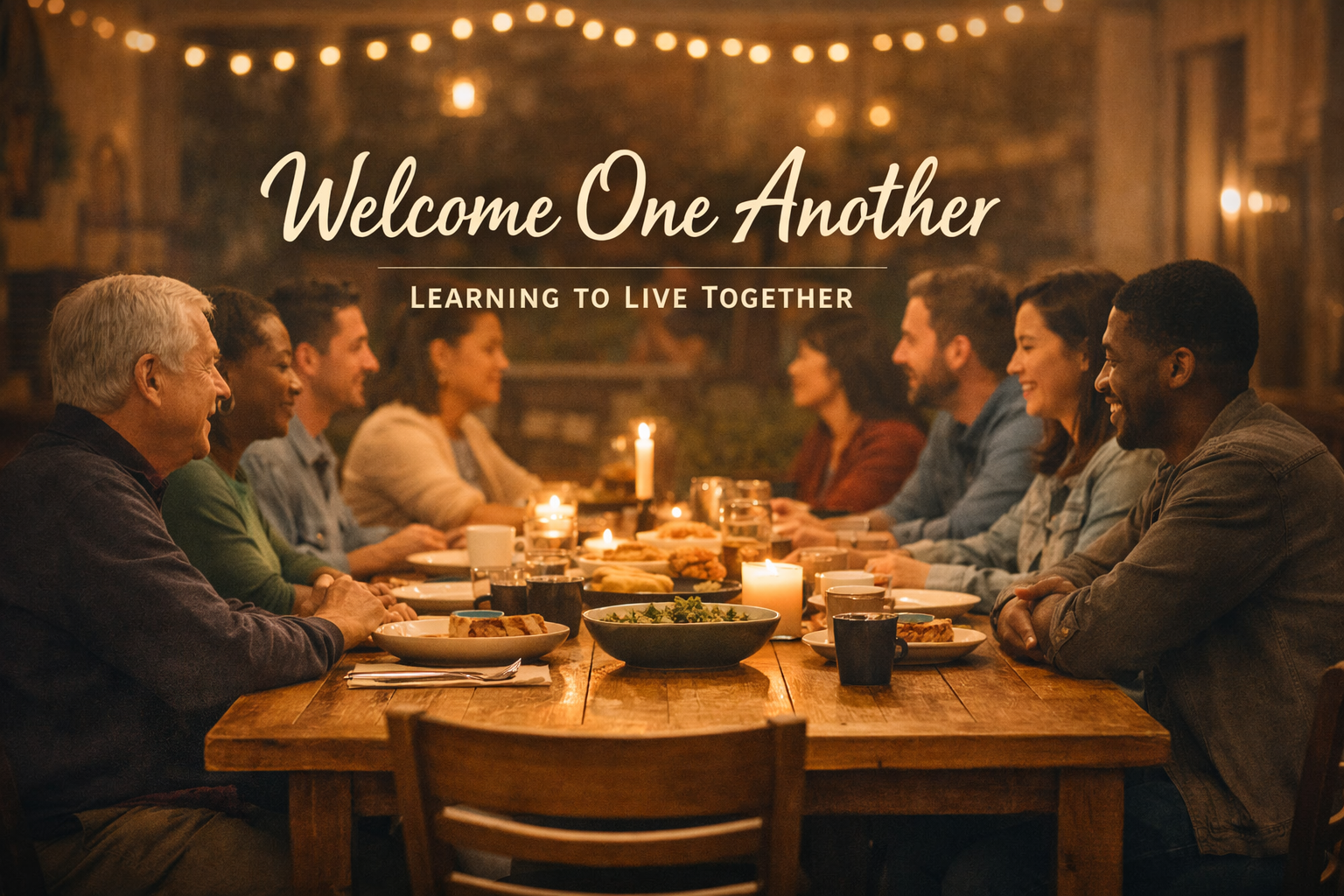
“Welcome one another, therefore, just as Christ has welcomed you.” (Romans 15:7)
He doesn’t say, “Agree on everything.” He says, “Welcome.” Stay at the table. Make room. Practice patience. Choose restoration.
This isn’t a call to try harder. It’s an invitation to live into who we already are. We are a people shaped by grace, learning to live together as one family in Christ. Not perfectly—but intentionally. Not as a checklist—but as a way of life formed by the Spirit.
As we close this Romans series, I’m grateful for the ways you’ve leaned into this journey. Paul’s letter reminds us that faith is not only personal—it is communal. We are learning to live together in grace.
This Wednesday we begin the season of Lent with a new series called “Falling.” Guided by the Stations of the Cross, this series will invite us to walk with Jesus into the places where the ground gives way —discovering that Christ meets us in our weakness, our vulnerability, and our waiting, and does not leave us there alone. If Romans has been about learning to live together in the life of the Spirit, this next season will help us explore how God meets us when we fall and leads us forward again.
For now, we carry Paul’s invitation with us:
open the gift of belonging, stay at the table, and keep learning to live together.
Key Scripture
Romans 1:7
Romans 8:1-11
Romans 15:7
Key Takeaways
- Identity precedes transformed behavior – Belonging to God arrives before moral mastery; sainthood functions as an identity that shapes decisions, not as a prize earned by conduct. When identity leads, actions flow from who people already are, which reduces anxiety about proving worth and redirects energy toward faithful practices of mercy and reconciliation. This reframes growth as response to grace rather than as compliance to rules. [24:13]
- Live within the Spirit’s domain – Two atmospheres govern life: the domains of the flesh and the Spirit. Flesh is not the material while Spirit is the immaterial. Rather, flesh is the domain of which fosters condemnation and death and Spirit is the domain which fosters life, peace, and restoration. Choosing the Spirit means rearranging routines and speech to assume grace, prioritize restoration, and cultivate communal health. Such movement requires intentional steps, not mere optimism—habit, liturgy, and mutual accountability open the new domain. [36:56]
- Practice welcome and patient presence – Welcoming one another does not require agreement; it demands space, steady presence, and a refusal to eject those who falter. Patience proves necessary because transformation often proceeds slowly and unevenly. Staying at the table trains the community to embody Christ’s hospitable work. This practice turns belonging into a formative discipline rather than a reward. [41:07]
- Refuse condemnation; choose restoration – Condemnation enforces obedience and fractures relationships; restoration rebuilds them by releasing debts and offering repeated forgiveness. The community must reject the impulse to sort others and instead cultivate listening, debt release, and tangible pathways home for those who wander. Restoration intentionally replaces punishment with practices that restore dignity and relational wholeness. [45:05]
Questions for Reflection
Why do you think Paul emphasizes that there is “no condemnation” for those in Christ (Romans 8:1), and how might condemnation work against the gospel?
The idea of “welcoming one another as Christ has welcomed you” (Romans 15:7) doesn’t require agreement. What does it require, and why is that sometimes harder than just agreeing? [41:07]
Identity precedes behavior—we don’t behave to become saints; we behave *because* we are saints. Where in your life are you still trying to “earn” your belonging rather than living out of the identity you already have in Christ? [27:21]
Living in the Spirit means intentionally moving away from habits of suspicion, labeling, or keeping score. What’s one relationship where you need to assume grace first instead of assuming the worst? [39:32]
Welcoming others as Christ welcomed us means making space even when it’s uncomfortable. Who is one person God might be inviting you to “stay at the table” with, even amid disagreement or difference? [42:09]
Refusing condemnation is a choice. When have you felt the pull to condemn someone else—or yourself—and what would it look like to choose restoration instead in that situation? [44:21]
Patience is needed because we’re all “a work in progress.” Where do you need to extend patience to others in your spiritual community? Where do you need to receive it? [42:58]
Recommended Posts

Deliver Us: Never in a Million Years
September 28, 2026

Deliver Us: All I Ever Wanted
September 22, 2026

Deliver Us: God Hears Our Cry
September 15, 2026